Chain of Custody in the Digital Age: Best Practices for Evidence Management
The chain of custody—the chronological documentation of who handled evidence, when, where, and under what circumstances—has always been fundamental to legal proceedings. In traditional investigations, maintaining this chain involved physical logs, signatures, and careful documentation of each transfer. However, the digital age has fundamentally transformed evidence management, introducing new complexities while simultaneously offering powerful new tools to ensure custody integrity. Modern digital evidence management requires sophisticated approaches that leverage automation, cryptography, and comprehensive audit trails to maintain the rigorous standards demanded by courts.
The Evolving Challenge of Digital Evidence Custody
Digital evidence differs from physical evidence in several critical ways that complicate custody management:
Volume and Velocity
Modern investigations generate enormous volumes of digital evidence. A single smartphone can contain hundreds of thousands of files, messages, and metadata. Cloud storage services compound this complexity, with evidence distributed across multiple servers and jurisdictions. Traditional manual logging approaches cannot scale to handle this volume effectively.
Invisible Transfers
Unlike physical evidence, digital evidence can be transferred instantaneously and invisibly. A file can be copied, shared, or accessed remotely without any visible indication of the transfer. This invisibility requires automated systems that can track every access and modification, even when human observers aren't present.
Fragility
Digital evidence is inherently fragile. A single bit flip, accidental deletion, or unauthorized modification can render evidence inadmissible or unreliable. Custody controls must not only track who accessed evidence but also ensure that access didn't result in alteration or corruption.
Multiplicity
Digital evidence exists in multiple forms simultaneously. A single email might exist as an original file, a backup copy, a printed version, and a forensic image. Each instance must maintain its own custody chain while establishing relationships between related copies.
Automated Logging: The Foundation of Modern Custody Management
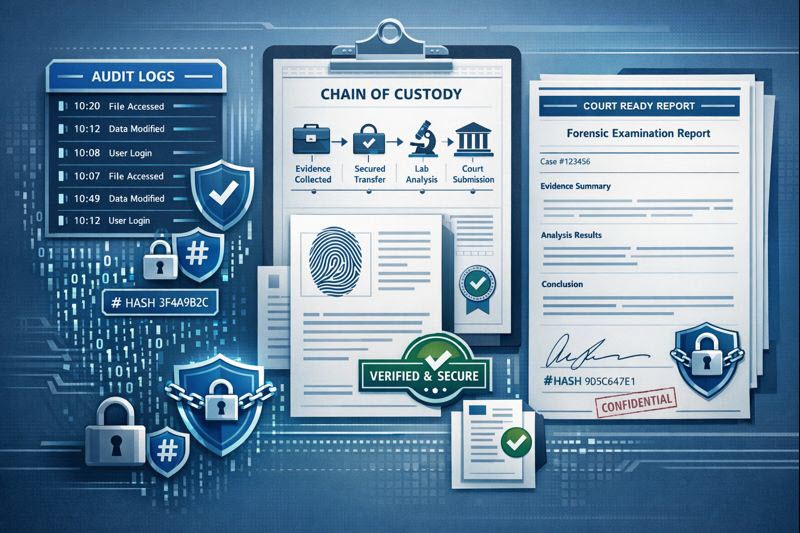
Automated logging systems form the foundation of modern digital evidence custody management. Unlike manual logs that can be forgotten, lost, or falsified, automated systems provide real-time, tamper-evident records of all interactions with evidence.
Comprehensive Activity Logging
Effective automated logging captures detailed information about every interaction with digital evidence:
- Access Events: Who accessed evidence, when, and from where
- Modification Events: Any changes made to evidence, including who made them and why
- Transfer Events: Movement of evidence between systems, locations, or individuals
- Export Events: When evidence is exported or copied, including destination and purpose
- Viewing Events: Even read-only access should be logged to establish comprehensive custody
These logs must be generated automatically—not relying on users to remember to log their actions—and stored in a manner that prevents tampering or deletion.
Real-Time Logging
Modern systems provide real-time logging that captures events as they occur, not as after-the-fact documentation. This immediacy is critical because:
- Forensic Integrity: Immediate logging reduces the window during which unauthorized access could occur without detection
- Investigation Continuity: Real-time logs provide investigators with current information about evidence status
- Compliance Assurance: Immediate logging demonstrates compliance with custody requirements throughout an investigation, not just at audit time
Immutable Storage
Automated logs must be stored in a manner that prevents modification or deletion. This immutability is typically achieved through:
- Write Once, Read Many (WORM) Storage: Storage media that physically prevents rewriting
- Cryptographic Sealing: Digital signatures that make any tampering detectable
- Distributed Storage: Copies stored in multiple locations make tampering practically impossible
- Blockchain Integration: Distributed ledger technology that creates tamper-proof custody records
Cryptographic Verification: Ensuring Integrity
Cryptographic techniques provide mathematical guarantees of evidence integrity that physical custody methods cannot match. These techniques enable verification that evidence hasn't been modified, even if the verification occurs long after the evidence was handled.
Digital Signatures
Digital signatures use public-key cryptography to authenticate the origin and integrity of evidence and custody records. Each custody event can be digitally signed by the responsible party, creating a cryptographic seal that:
- Authenticates Identity: Verifies who handled the evidence
- Ensures Integrity: Detects any modification to the signed data
- Provides Non-Repudiation: Prevents individuals from denying their actions
Digital signatures use asymmetric cryptography, where a private key signs data and a corresponding public key verifies the signature. This means that while anyone can verify a signature (using the public key), only the holder of the private key could have created it.
Cryptographic Hashing
Cryptographic hashing generates unique digital fingerprints for evidence files. Hash functions like SHA-256 create fixed-length outputs (hashes) that change dramatically if even a single bit of the input changes. This property enables:
- Integrity Verification: Comparing current hashes to original hashes detects any modification
- Deduplication: Identifying identical files across multiple systems
- Verification Chains: Linking evidence to its source through hash relationships
When evidence is first collected, its hash value is calculated and recorded. Any subsequent access can verify the hash to confirm the evidence remains unaltered. Even if custody records are incomplete, hash verification can prove that evidence hasn't been modified.
Blockchain for Custody Tracking
Blockchain technology provides a decentralized, immutable ledger for recording evidence custody events. Each transaction (custody event) is:
- Timestamped: Accurately records when the event occurred
- Cryptographically Linked: Connected to previous transactions in a tamper-proof chain
- Distributed: Stored across multiple nodes, making alteration practically impossible
- Verifiable: Anyone with access can verify the entire custody chain
While blockchain technology is still emerging in evidence management applications, it offers unique advantages for maintaining custody records that must withstand rigorous legal scrutiny.
Comprehensive Audit Trails
While automated logging captures individual events, comprehensive audit trails provide the context and analysis necessary to reconstruct complete custody histories. Effective audit trails include:
Chronological Reconstruction
Audit trails organize individual log entries into chronological narratives that reconstruct complete custody histories. This reconstruction enables:
- Timeline Analysis: Understanding the sequence of events that affected evidence
- Gap Detection: Identifying periods where custody documentation is missing
- Pattern Recognition: Detecting unusual access patterns that might indicate problems
Correlation and Analysis
Sophisticated audit trail systems correlate related events across multiple evidence items, users, and systems. This correlation enables:
- Relationship Mapping: Understanding how different pieces of evidence relate to each other
- Access Pattern Analysis: Identifying unusual or suspicious access patterns
- Compliance Verification: Automatically checking custody practices against policy requirements
Reporting and Presentation
Audit trails must be presentable in court. Effective systems generate reports that:
- Are Human-Readable: Presented in formats that legal professionals can understand
- Include Context: Provide sufficient detail to establish custody without overwhelming readers
- Support Verification: Enable independent verification of reported events
Best Practices for Modern Evidence Custody
Organizations managing digital evidence should implement several best practices:
Implement Immutable Storage Solutions
Use Write Once, Read Many (WORM) storage or blockchain-backed systems to prevent unauthorized modifications to evidence. These technologies provide physical or cryptographic guarantees that evidence cannot be altered after initial storage.
Enforce Role-Based Access Controls
Restrict evidence access to authorized personnel based on their roles and responsibilities. Access controls should enforce the principle of least privilege, granting individuals only the minimum access necessary for their functions.
Maintain Comprehensive Audit Trails
Ensure that all interactions with digital evidence are logged in detail, including user actions, timestamps, and any changes made. These audit trails must be stored separately from the evidence itself and protected against tampering.
Regularly Verify Evidence Integrity
Periodically validate the integrity of evidence using cryptographic hashes and digital signatures to detect any unauthorized alterations. Regular verification provides ongoing assurance that custody controls remain effective.
Adopt Secure Timestamping Mechanisms
Implement trusted timestamping to accurately record the time of each custody event. Trusted timestamping services provide independent verification of timestamps, enhancing their legal defensibility.
Establish Clear Custody Policies
Develop and document clear policies governing evidence custody, including:
- Who can access evidence under what circumstances
- Procedures for transferring evidence between individuals or systems
- Requirements for documenting custody events
- Consequences for violating custody policies
Train Personnel
Ensure all personnel who handle digital evidence understand custody requirements and the systems used to maintain custody. Training should emphasize both the legal importance of custody and the practical procedures for maintaining it.
Regular Compliance Audits
Conduct regular internal audits to verify that custody practices comply with policies and legal requirements. These audits should review both automated logs and manual procedures to ensure comprehensive compliance.
Integration with Legal Proceedings
Effective custody management doesn't exist in isolation—it must support legal proceedings. Modern custody systems should:
Support Expert Testimony
Provide reports and documentation that forensic experts can use to testify about evidence custody in court. These materials should be clear, comprehensive, and verifiable.
Enable Adversarial Examination
Design custody documentation to withstand adversarial examination. Defense attorneys should be able to review custody records and verify that evidence wasn't tampered with or improperly handled.
Maintain Long-Term Accessibility
Preserve custody records for the duration required by law, which may be years or decades. Systems must ensure that custody documentation remains accessible and verifiable long after investigations conclude.
The Future of Evidence Custody
As digital evidence continues to evolve, custody management will face new challenges and opportunities. Emerging technologies like artificial intelligence for automated custody monitoring, quantum-resistant cryptography for long-term security, and decentralized identity systems for authentication will shape the future of evidence management.
However, the fundamental principles remain constant: custody must be comprehensive, verifiable, and defensible. The tools may change, but the requirement for rigorous documentation and integrity verification endures.
Conclusion
Maintaining chain of custody for digital evidence in the modern era requires sophisticated approaches that leverage automation, cryptography, and comprehensive audit trails. These technologies don't replace the fundamental principles of custody management—they enhance them, providing capabilities that manual methods cannot match.
Organizations that implement these modern best practices position themselves to meet the rigorous custody standards demanded by courts while managing the enormous volumes of digital evidence characteristic of contemporary investigations. By combining automated logging, cryptographic verification, and comprehensive audit trails, they can maintain custody integrity at scale while supporting the legal proceedings that depend on evidence reliability.